A Short History of 25 Dublin Hotels
A former bank’s domed hall, a nurses’ home turned boutique hotel, a castle near the 1014 battlefield, and the quayside hotel Bono and The Edge have owned since 1992.
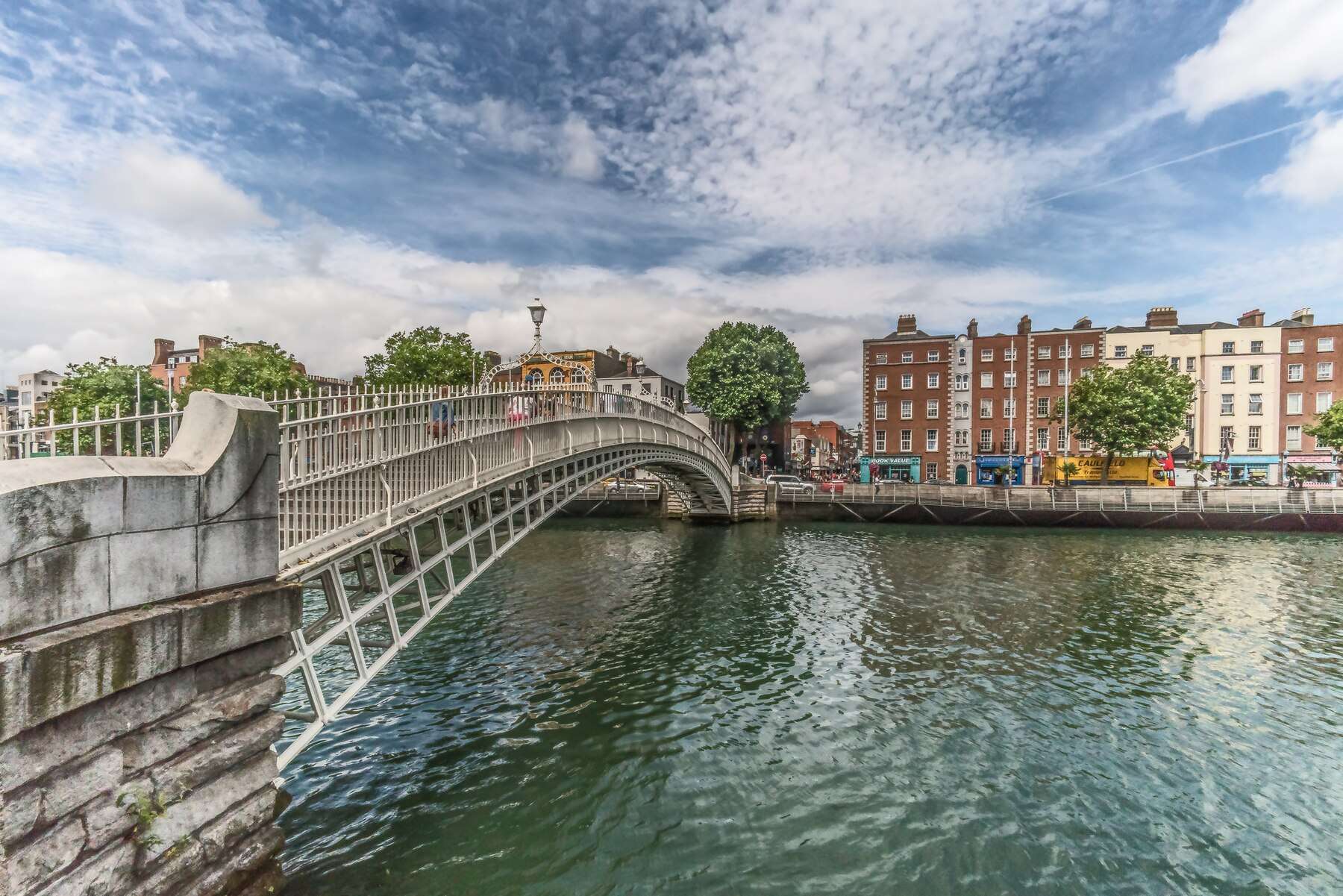
Dublin kept its Georgian terraces, its old banks, and a schoolhouse or two, and turned a good many of them into hotels. This list has the former bank with its domed hall still intact on College Green, the nurses’ home behind a 1900 red-brick front, the castle out at Clontarf near the 1014 battlefield, and the quayside hotel that U2 bought in 1992.
The list is grouped by character, not ranked. Where a hotel’s own site could be confirmed, its name links there; the rest are listed without one.
The grand old names
The Shelbourne · St Stephen’s Green
The Shelbourne opened in 1824, when Martin Burke took over townhouses on the north side of St Stephen’s Green. The Constitution of the Irish Free State was drafted here in 1922, in the room still called the Constitution Suite. The present building is an 1860s rebuild, fronted by the cast-iron statues that hold its lamps, added in 1867.
Riu Plaza The Gresham Dublin · O’Connell Street
The Gresham was founded in 1817 by Thomas Gresham on what was then Sackville Street, now O’Connell Street. It is where James Joyce set the close of ‘The Dead’, the night Gabriel and Gretta Conroy spend in the city. The hotel was gutted in the 1922 Battle of Dublin and rebuilt, reopening in 1927.
The Merrion · Upper Merrion Street
The Merrion was made from four restored 1760s Georgian townhouses on Upper Merrion Street and opened in 1997. One of them, Mornington House, is a claimed birthplace of the Duke of Wellington in 1769. The hotel holds one of Ireland’s largest private art collections, hung through its public rooms.
Wynn’s Hotel · Lower Abbey Street
Wynn’s was founded in 1845 on Lower Abbey Street, a short walk from the GPO. Cumann na mBan, the women’s republican organisation, was founded here in 1914, and a meeting the year before helped set up the Irish Volunteers. The hotel was destroyed by fire in the 1916 Easter Rising and rebuilt, reopening in 1926.
Royal Marine Hotel · Dun Laoghaire
The Royal Marine stands above Dun Laoghaire harbour and Dublin Bay, in a grand Victorian building of 1865. It was designed by John McCurdy, the architect who also worked on the Shelbourne.
Used to be something else
The College Green Hotel · College Green
The College Green occupies a grand 19th-century former bank, and the old domed banking hall survives as an events room still called the Banking Hall. It traded as the Westin Dublin until it was rebranded The College Green, part of the Autograph Collection, in 2023.
The Schoolhouse Hotel · Ballsbridge
The Schoolhouse is set in St Stephen’s Parochial School, a Victorian parish schoolhouse that dates to 1859. It stands beside the Grand Canal at Mount Street Bridge, where some of the fiercest fighting of the 1916 Rising took place. It opened as a hotel in 1998.
The Davenport · Merrion Square
The Davenport was built behind the preserved 1863 facade of Merrion Hall, a large meeting hall of the Plymouth Brethren. Merrion Hall gets a mention in Joyce’s Ulysses. It opened as the Davenport in 1993.
The Dylan Hotel · Ballsbridge
The Dylan is in a red-brick building of 1900 that began as the nurses’ home of the City of Dublin Hospital. It was converted and opened as the Dylan in 2006.
Castles and estates
Clontarf Castle Hotel · Clontarf
A castle has stood on this site since about 1172, near the ground of the Battle of Clontarf of 1014. The present baronial castle was rebuilt in 1837 to designs by William Vitruvius Morrison.
Fitzpatrick Castle Hotel · Killiney
Fitzpatrick Castle is a castellated manor house of 1741, built as Killiney Castle above Killiney Bay. The Fitzpatrick family has run it as a hotel since 1971.
Portmarnock Resort & Jameson Golf Links · Portmarnock
Portmarnock is built around St Marnock’s House, the former seaside home of the Jameson whiskey family. Its links course was relaunched in 2024 as the Jameson Golf Links, named for them.
Georgian and Victorian houses
Number 31 · Leeson Close
Number 31 joins a Georgian townhouse on Fitzwilliam Place to a 1960s modernist mews that was the home of the architect Sam Stephenson. Stephenson was one of Ireland’s most prominent and most argued-over modern architects, behind the Central Bank and the Civic Offices.
Buswells Hotel · Molesworth Street
Buswells occupies a terrace of Georgian townhouses on Molesworth Street, directly across from Leinster House, the seat of the Irish parliament. It has run as Buswells since 1882, and its place beside the Dáil has long made it an informal meeting spot for TDs and senators.
Townhouse on the Green · St Stephen’s Green
Townhouse on the Green is a nine-room hotel in a Georgian house at 22 St Stephen’s Green. The building traded for years as the Cliff Townhouse before taking its present name.
The Wilder · Adelaide Road
The Wilder is set in a restored red-brick Victorian building on Adelaide Road, near St Stephen’s Green. It takes its name in a nod to Oscar Wilde and opened as a townhouse hotel in 2017.
Ariel House · Ballsbridge
Ariel House is made from three restored Victorian townhouses on Lansdowne Road, near the Aviva Stadium. The houses date to around the 1850s.
Harrington Hall · Harcourt Street
Harrington Hall occupies a pair of Georgian townhouses at 69-70 Harcourt Street. Number 70 was the home of Timothy Charles Harrington, a nationalist MP and three-time Lord Mayor of Dublin, who gives the house its name.
Staunton’s on the Green · St Stephen’s Green
Staunton’s is a Georgian townhouse guesthouse on the south side of St Stephen’s Green. Its back garden opens onto the Iveagh Gardens, one of Dublin’s hidden walled parks.
The Mont Dublin · Merrion Street
The Mont is in a Georgian corner building where Merrion Street Lower meets Clare Street, across from the National Gallery of Ireland. It traded for years as the O’Callaghan Mont Clare before it was renamed The Mont.
Characters old and new
Blooms Hotel · Temple Bar
Blooms is named for Leopold Bloom, the central character of Joyce’s Ulysses, and stands on Anglesea Street in Temple Bar. A large street mural by the Dublin artist James Earley covers one side of it.
The Central Hotel · Exchequer Street
The Central opened in 1887 on Exchequer Street, in a red-brick and terracotta building in the middle of the city. Its first-floor Library Bar is a long-running Dublin snug, lined with books and armchairs.
Anantara The Marker Dublin · Grand Canal Square
The Marker is a modern landmark on Grand Canal Square in the docklands, its stone facade cut into a faceted checkerboard. It opened as The Marker in 2013 and later took the Anantara name when the brand took over its management.
The Clarence · Temple Bar
The Clarence sits on Wellington Quay, looking over the Liffey. A hotel has run on the site since 1852, and the present one was bought in 1992 by Bono and The Edge of U2, who still own it.
The Fitzwilliam Hotel · St Stephen’s Green
The Fitzwilliam opened in 1998 on the west side of St Stephen’s Green. Its interiors were designed by Terence Conran.
Frequently Asked Questions
Are these hotels ranked?
No. The groups sort them by character, and the order within each group carries no meaning.
What made a hotel interesting enough for this list?
A story. Every entry was a bank, a schoolhouse, a Georgian townhouse, a castle, or a building tied to Dublin’s history or its writers. Comfort alone did not qualify a hotel.
Why are there no prices?
Rates change daily and a priced list goes stale in a month. Where a hotel runs its own site, its name links there, so you see the current rate and book direct.
Which hotel puts me closest to the day trips on this site?
Most day trips from Dublin leave by coach from the city centre or by train from Connolly, Heuston, or Pearse station. The hotels around St Stephen’s Green and O’Connell Street sit closest.
Do the small hotels book out faster than the grand ones?
Usually. The small townhouse hotels — Number 31, Ariel House, Staunton’s on the Green — hold few rooms and fill first. Book those well ahead.